When life feels like too much and you don't have much control over any of it, your breath is one of the few things you can usually still change. Your water intake too, as long as there's no medical reason you can't.
Controlled breathing can support coping with anxiety, grief and overwhelm. I'm an EMDR therapist in North Adelaide, and it's one of the skills we can build in the preparation phase of EMDR therapy.
What happens in your body when you breathe slowly
Your heart speeds up a little when you breathe in and slows down when you breathe out. Slow breathing makes that swing bigger. This is called heart rate variability, and it's one way of measuring how well your body can shift between alert and settled.
Research on slow breathing, which is around 4 to 10 breaths a minute compared with the usual 10 to 20, has found effects on heart rate variability, on how your body regulates blood pressure, and on the balance between the parts of your nervous system that speed you up and slow you down. A review of slow breathing studies also found changes in brain activity linked with calm, alert states, and people said they felt more relaxed and less anxious.
Why the out-breath matters
When you breathe out, the vagus nerve slows your heart. Some studies have found that making your out-breath longer than your in-breath increases the heart rate variability measures linked to vagal activity, and that it can help people feel more relaxed. Not every study has found a difference, so I'd treat a longer out-breath as something worth trying, not a rule.
It's also the idea behind cyclic sighing, which is two breaths in, then one long slow breath out. In a Stanford study, people practised for five minutes a day for a month. Everyone improved, and cyclic sighing did best for lifting mood and lowering breathing rate.
Different patterns work for different people
There's no single pattern that suits everyone. The breathing rate that works best varies from person to person, and for most adults it sits somewhere between about 4.5 and 6.5 breaths a minute. In one small study, breathing a little faster or slower than someone's ideal rate had similar effects, so you don't need to find a perfect number.
Some patterns to try:
Longer out-breath: in for 4, out for 6.
Cyclic sighing: two breaths in, one long slow breath out.
Box breathing: in, hold, out, hold, all the same length.
Pursed-lip breathing: breathing out through slightly closed lips, which gives you more control over a long, slow out-breath.
Some people find the holds uncomfortable. Some find a long out-breath easier than counting. Try a few and notice what feels okay in your body. The breathing pacer on my resources page has several patterns to try.
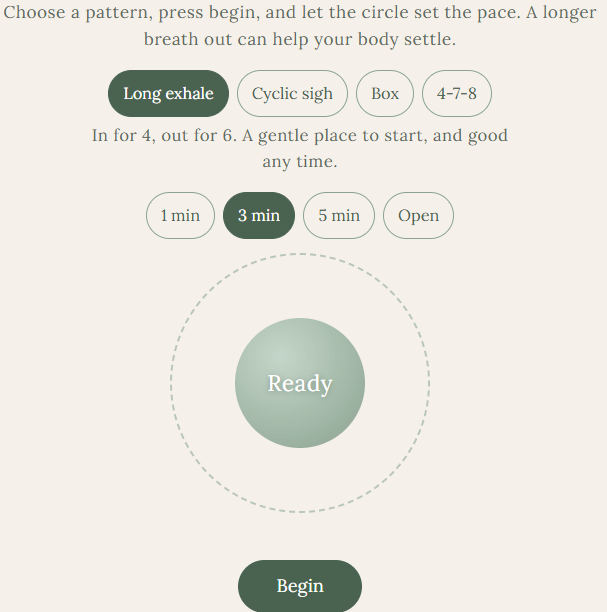
You can try out guided practice on my Resources page. Nothing you do in it is saved or collected.
Does it help with anxiety?
A review of 12 trials found small to moderate drops in stress, anxiety and depression symptoms for people who practised breathing exercises. Controlled breathing gives you something to do when you feel out of control. You can't always change what's happening, but you can change how you're breathing.
Practise before you need it
Using your breath on purpose to settle your body is a skill, and skills take practice.
Please don't try a breathing exercise for the first time in the middle of a panic attack. If you've never practised, it won't be there when you need it, and it's easy to decide that breathing doesn't work for you. Practise when you're feeling okay, even for a couple of minutes. That way it's ready when things get harder. This goes for anxiety and panic, and for grief too, when it comes in waves.
Breathing and EMDR preparation
Before any EMDR processing, there's some groundwork to do. We talk about what helps you feel safe, what happens when your emotions get big, and how to stay connected when things feel hard. We go slow so we can go fast later. Breathing is one of the coping skills we might practise during this stage. You can read more about what EMDR therapy involves.
When breathing makes things worse
All of this is for breathing when there's no trauma activation. For some people, focusing on the breath sets things off. If that's you, nothing has gone wrong. It just means we need to slow down even further.
We'd add some scaffolding. Maybe we only focus on the breath for a second. You might hold your hand in front of your mouth and notice whether the breath feels warm on your skin. Then you move your hand a bit further away and see if it feels cooler. That might be where we start. If breathing isn't helpful for you, we might not use it as a coping skill. We might still use it on purpose for things like present moment awareness, dual attention and mindfulness.
Learn it with someone
What I've written here is general. In therapy, it would be changed to suit you, and it helps to practise together so we can see how your body reacts and adjust.
I see adults for EMDR therapy in North Adelaide and online across Australia. You can read about trauma and anxiety support, or book an appointment. If you'd like to ask a question first, you can get in touch.
If you'd like to try a guided breathing practice, there's a free breathing pacer on my resources page. Nothing you do in it is saved or collected.
This is general information and doesn't replace advice from a health professional. If you're in crisis, call Lifeline on 13 11 14.
References
Russo, M. A., Santarelli, D. M., & O'Rourke, D. (2017). The physiological effects of slow breathing in the healthy human. Breathe, 13(4), 298–309.
Zaccaro, A., et al. (2018). How breath-control can change your life: a systematic review on psycho-physiological correlates of slow breathing. Frontiers in Human Neuroscience, 12, 353.
Van Diest, I., et al. (2014). Inhalation/exhalation ratio modulates the effect of slow breathing on heart rate variability and relaxation. Applied Psychophysiology and Biofeedback, 39, 171–180.
Increased exhalation to inhalation ratio during breathing enhances high-frequency heart rate variability in healthy adults. (2021). Psychophysiology, 58(11), e13905.
Lehrer, P. M., & Gevirtz, R. (2014). Heart rate variability biofeedback: how and why does it work? Frontiers in Psychology, 5, 756.
Acute effects of resonance frequency breathing on cardiovascular regulation. (2019). Physiological Reports.
Psychophysiological responses to various slow, deep breathing techniques. (2021). Psychophysiology, 58(2), e13712.
Balban, M. Y., et al. (2023). Brief structured respiration practices enhance mood and reduce physiological arousal. Cell Reports Medicine, 4(1), 100895.
Fincham, G. W., et al. (2023). Effect of breathwork on stress and mental health: A meta-analysis of randomised-controlled trials. Scientific Reports, 13, 432.
