How Long Does EMDR Therapy Take? And How It's Tailored to You
Eye Movement Desensitisation and Reprocessing (EMDR) therapy is a versatile and adaptive approach designed to address traumatic memories and associated distress. Recognising that each individual's healing journey is unique, EMDR offers various methods to tailor the therapeutic experience to individual needs.
Understanding EMDR Therapy
EMDR therapy is a structured, evidence-based therapy that helps people process and heal from distressing memories and trauma. It works by using bilateral stimulation, most commonly guided eye movements, to help the brain integrate difficult experiences that may have become "stuck."
If you'd like a deeper understanding of how EMDR works and what to expect across each stage, you can read more in our guide to the 8 phases of EMDR therapy.
What many people don't realise is that EMDR isn't a one-size-fits-all approach. There are different ways it can be delivered, and the intensity and method can be adjusted to suit where you are in your healing journey. Below are some examples.
How long does EMDR therapy take?
Healing is not a one-size-fits-all process. Some people feel relief after just a few sessions, while others need more time to establish safety before moving into deeper processing. Trauma processing typically takes place in the mid-to-late stages of therapy. For single-incident traumas, it may take just 2-4 processing sessions, while complex trauma often requires more in-depth work. For clients engaged in long-term therapy, EMDR can be integrated as part of their overall treatment, with trauma processing sessions spaced over time
One of the benefits of EMDR is that there are different intensities and ways to approach therapy. We aim to begin some level of processing within the first few sessions while ensuring that you feel safe and resourced. The pace will always be adjusted to what feels right for you.
Adapting EMDR Therapy to your needs
EMDR is a flexible therapy that can be adapted to meet your needs. Not everyone processes distress in the same way, so we adjust the intensity and approach to ensure you feel safe and supported. Think of EMDR as existing on a continuum, where we can adjust the "power level" based on what feels right for you. Here are some of the different ways EMDR can be done:
The EMDR Continuum
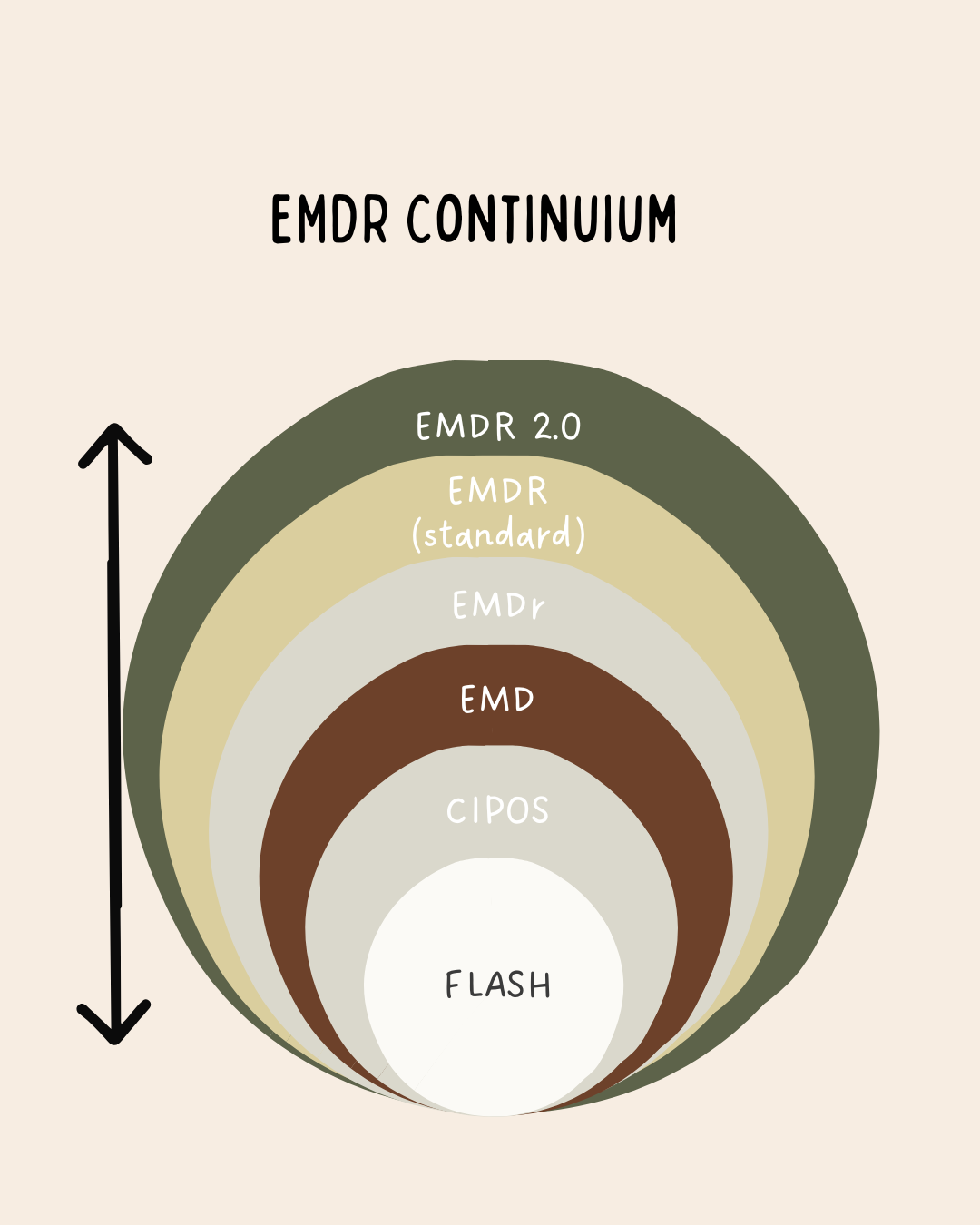
EMDR 2.0 – A newer adaptation that incorporates stronger stimulation and cognitive interweaves to accelerate processing for some clients.
Traditional EMDR (Standard Protocol) – This follows the full eight-phase model, working through distressing memories with bilateral stimulation while integrating grounding and resourcing techniques.
EMD (Eye Movement Desensitisation) – A more contained approach that focuses on reducing distress around a specific memory without fully reprocessing it.
EMD "Little r" – A lower-intensity form of EMDR that helps process difficult memories in a more gradual and controlled way.
CIPOS (Constant Installation of Present Orientation and Safety) – A method designed for individuals with complex trauma, ensuring a strong sense of safety while processing distress.
Flash Technique – A gentler approach that allows processing to occur with minimal distress, often used when traditional EMDR feels too intense.
Regardless of which approach we use, EMDR is tailored to go at your pace. Everyone can benefit from EMDR in different ways, and together, we will find the right intensity that works for you.
EMDR Therapy in Adelaide
If you are based in Adelaide and want to explore which approach might suit you, feel free to get in touch. Clients often work with me at Warming Light Counselling to address anxiety, self-esteem issues, grief, and trauma. I also offer telehealth appointments online for clients Australia-wide.
